
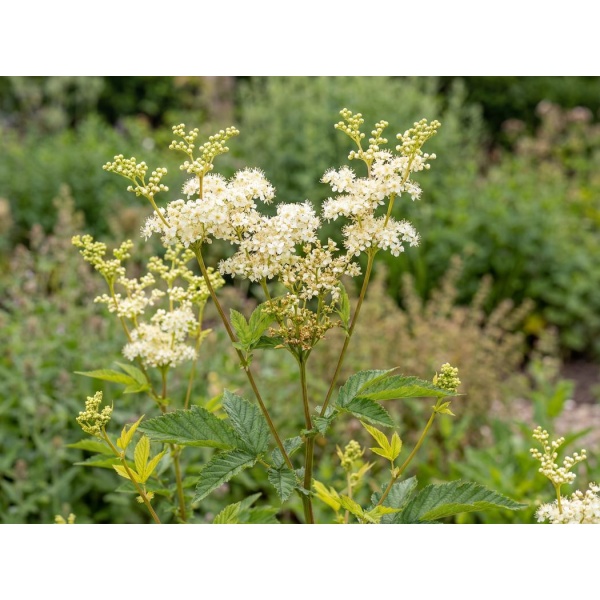
Filipendula ulmaria

$27.99
Filipendula ulmaria brings fragrant, frothy cream-white summer flowers and deep green divided foliage to moist borders, rain gardens, and naturalistic waterside planting.
- Description
- Additional information
Description
Meadowsweet is a vigorous, clump-forming perennial for places where ordinary border plants can struggle with persistent moisture. Upright leafy stems rise through deep green, pinnately divided foliage and finish in airy panicles of tiny cream-white flowers. The many long stamens give the summer display its familiar frothy texture, while both flowers and leaves add fragrance. It works especially well in rain gardens, water gardens, wildflower meadows, and moist informal borders, where the blooms attract bees and many other insects.
Plant it in fertile, humus-rich clay or loam that stays consistently moist. Full sun produces a strong display when the soil never dries, while partial shade is useful where summer moisture is less reliable. Space plants about 75 cm apart so mature clumps can meet naturally without crowding. Water through dry periods, mulch with organic matter, and cut the stems back after flowering. Deadhead first if seedlings are not wanted, because the species can self-sow freely and may spread beyond its allotted space.
Before planting, check local invasive or noxious-weed rules: meadowsweet is restricted in some Midwestern states and should not be grown where it could escape into sensitive wet habitats. For personal safety, do not use it in homemade herbal preparations if you are sensitive to salicylates. In a suitable, managed site, its fragrant summer panicles, moisture tolerance, and wildlife value make it a distinctive choice for naturalistic planting.
Additional information
| Height | 50 cm – 100 cm |
|---|---|
| Spread | 50 cm – 100 cm |
| Flowering months | June, July, August |
| Synonyms | Spiraea ulmaria |
| Family | Rosaceae |
| Propagation | Sow seed in containers in spring, or divide established clumps in spring. |
| Pests | Generally pest-free. |
| Diseases | Powdery mildew may occur. |
| Pruning | Deadhead where self-seeding must be limited, then cut stems back after flowering. |
| Hazardous information | Do not use in homemade herbal preparations if you are sensitive to salicylates. |
| Hazardous | yes |
| Variegated | unknown |
| Watering instructions | Keep soil consistently moist; never let established plants dry out. |
| Sunlight instructions | Grow in full sun or partial shade; keep sunny sites consistently moist. |
| Color flower summer | White, Cream |
| Aspect | East, South, West, North |
| Foliage | Deciduous |
| Habit | Clump-former |
| Moisture | Wet or Damp Soil, Moist but Well Drained |
| Ph | Acid, Alkaline, Neutral |
| Position | Full sun, Partial shade |
| Scent | Fragrant |
| Shape | Upright |
| Suggest planting location | Flowering borders, Wildflower meadows, Bog Garden, Rain Garden, Water Garden |
| Type | Perennial |
| Use for | Bee-Friendly, Cutting Garden, Naturalizing |
| Years to max height | 2 |
| Drought resistance | no |
| Soil | Clay, Loam |
| Local names | Meadowsweet, European Meadowsweet, Queen of the Meadow |
| Blomidon Item No | MO23017970, ZFILUL0001G |
| Usps | Fragrant cream-white panicles create a frothy summer display., Handles wet ground in rain gardens, bog gardens, and water gardens. |