
Hemerocallis “Gentle Shepherd”

$27.99
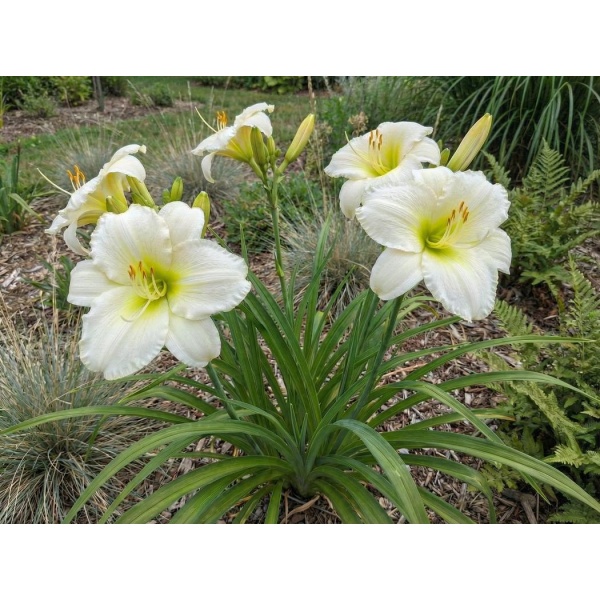
Hemerocallis ‘Gentle Shepherd’ opens large ivory summer flowers with green throats above a semi-evergreen clump in sunny or partly shaded borders.
- Description
- Additional information
Description
Large circular ivory flowers with green throats open in summer on Hemerocallis ‘Gentle Shepherd’. The single blooms rise above narrow, strap-shaped foliage on a clump-forming semi-evergreen perennial suited to flower borders, city courtyards, and cottage gardens.
Grow it in fertile, moist but well-drained soil in full sun for the best flowering; partial shade is also suitable. Water freely from spring through summer, cut back flower stems after flowering, and remove dead foliage as needed. The plant is toxic to cats if eaten, so keep it away from cats.
Additional information
| Height | 2 ft – 3 ft |
|---|---|
| Spread | 3 ft – 5 ft |
| Flowering months | May, June, July, August |
| Synonyms | Hemerocallis "Gentle Shepherd", Hemerocallis Gentle Shepherd |
| Family | Asphodelaceae |
| Hazardous | yes |
| Variegated | unknown |
| Color flower summer | Green, Ivory |
| Aspect | South, West |
| Foliage | Deciduous, Semi-evergreen |
| Habit | Clump-former |
| Moisture | Moist but Well Drained, Well Drained Soil |
| Ph | Acid, Alkaline, Neutral |
| Position | Full sun, Partial shade |
| Shape | Mound-forming |
| Suggest planting location | Urban and courtyard gardens, Flowering borders, Patio and container use, Cottage and informal gardens |
| Type | Perennial |
| Use for | Butterfly-Friendly, Low maintenance, Container Planting |
| Years to max height | 2 |
| Drought resistance | no |
| Soil | Chalk, Clay, Loam, Sand |
| Local names | Gentle Shepherd daylily |
| Blomidon Item No | MO23018749, 7937666514995, ZHEMGES001G, 201813208 |
| Usps | Circular ivory flowers open around green throats in summer., Its clump-forming habit suits borders and city courtyards., Large almost pure White and Cream flowers have fresh Green and Yellow throats. |
| Propagation | Divide in early spring or autumn, at least six weeks before the first frost. Divide every two to three years to maintain vigor; seedlings do not come true to the cultivar. |
| Pests | Daylily gall midge, aphids, thrips, slugs, and snails may occur. |
| Diseases | Rust, spring sickness in freeze-and-thaw climates, and crown rot in hot, humid conditions may occur. |
| Pruning | Cut back flower stems after flowering and remove dead foliage as needed. |
| Hazardous information | This daylily is toxic to cats if eaten; keep it away from cats. |
| Watering instructions | Water freely from spring through summer in well-drained soil. |
| Sunlight instructions | Plant in full sun; partial shade can reduce flowering. |