
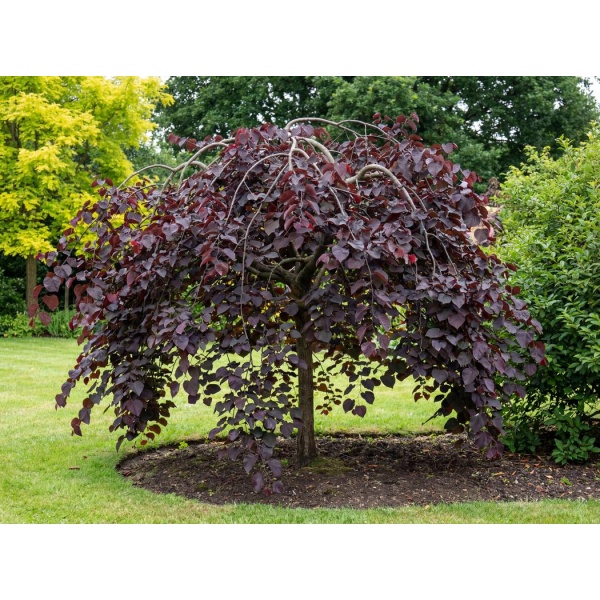
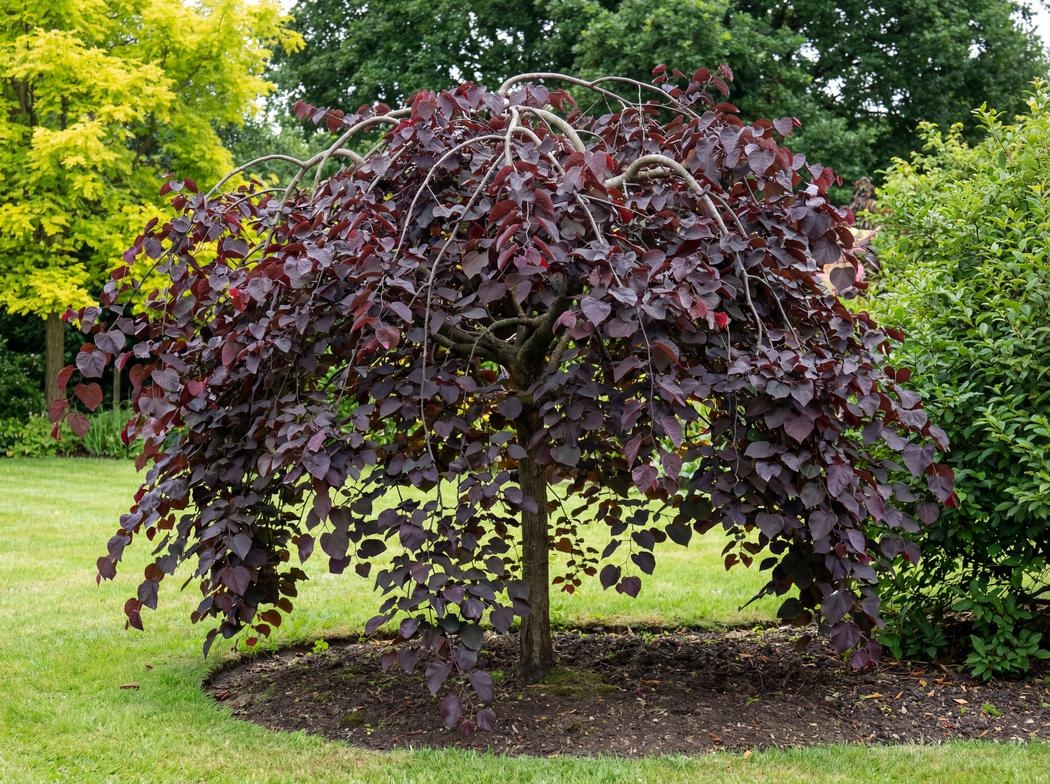
Cercis canadensis ‘Ruby Falls’
$329.99
Cercis canadensis Ruby Falls brings cascading branches, dark rose spring flowers, and maroon-red foliage to compact courtyards and small gardens.
- Description
- Additional information
Description
Cercis canadensis Ruby Falls forms a compact weeping tree with arching branches covered in dark rose flowers before the leaves appear. Heart-shaped foliage follows in maroon-red and purple, shifts toward green in late summer, and turns yellow in fall.
At roughly 5 to 8 feet tall and wide, this small tree fits courtyards, borders, and compact gardens. Plant it in full sun or partial shade in fertile, moist but well-drained soil. Prune lightly after flowering to maintain the canopy’s shape.
Additional information
| Height | 5 ft – 8 ft |
|---|---|
| Spread | 5 ft – 8 ft |
| Flowering months | April |
| Synonyms | Cercis canadensis 'Ruby Falls' |
| Family | Fabaceae |
| Hazardous | unknown |
| Variegated | unknown |
| Color flower spring | Purple, Pink |
| Aspect | East, South, West |
| Foliage | Deciduous |
| Habit | Compact, Pendulous |
| Moisture | Moist but Well Drained |
| Ph | Acid, Alkaline, Neutral |
| Position | Full sun, Partial shade |
| Shape | Weeping, Arching |
| Suggest planting location | Urban and courtyard gardens, Wall and boundary borders, Architectural planting, Cottage and informal gardens |
| Type | Tree |
| Use for | Architectural, Low maintenance, Pollinator-Friendly |
| Years to max height | 10 |
| Soil | Chalk, Clay, Loam, Sand |
| Local names | Eastern Redbud, Judas Tree, Love Tree, Ruby Falls Redbud, Ruby Falls Weeping Redbud |
| Blomidon Item No | MO23050583, CERCARF1507G, CERCARF25015G, 201637402, 201960972, 202065970, 202017242, 202069688, 202025284, 202020981 |
| Usps | Dark rose spring flowers cascade from bare, arching branches., Its compact weeping form suits courtyards and small gardens., Give full sun or partial shade and moist, well-drained soil. |
| Propagation | Propagate by semi-hardwood cuttings. |
| Pests | Watch for leafhoppers and scale insects. |
| Diseases | Watch for verticillium wilt, coral spot, honey fungus, canker, dieback, leaf spots, mildew, and blight. |
| Pruning | Prune lightly after flowering to maintain the canopy's shape. |
| Watering instructions | Keep soil evenly moist but well drained, especially while establishing. |
| Sunlight instructions | Grow in full sun, with partial shade in hot summer climates. |