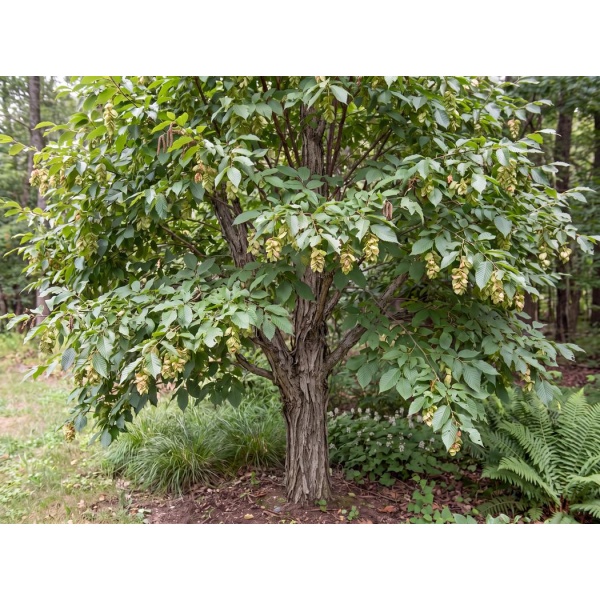
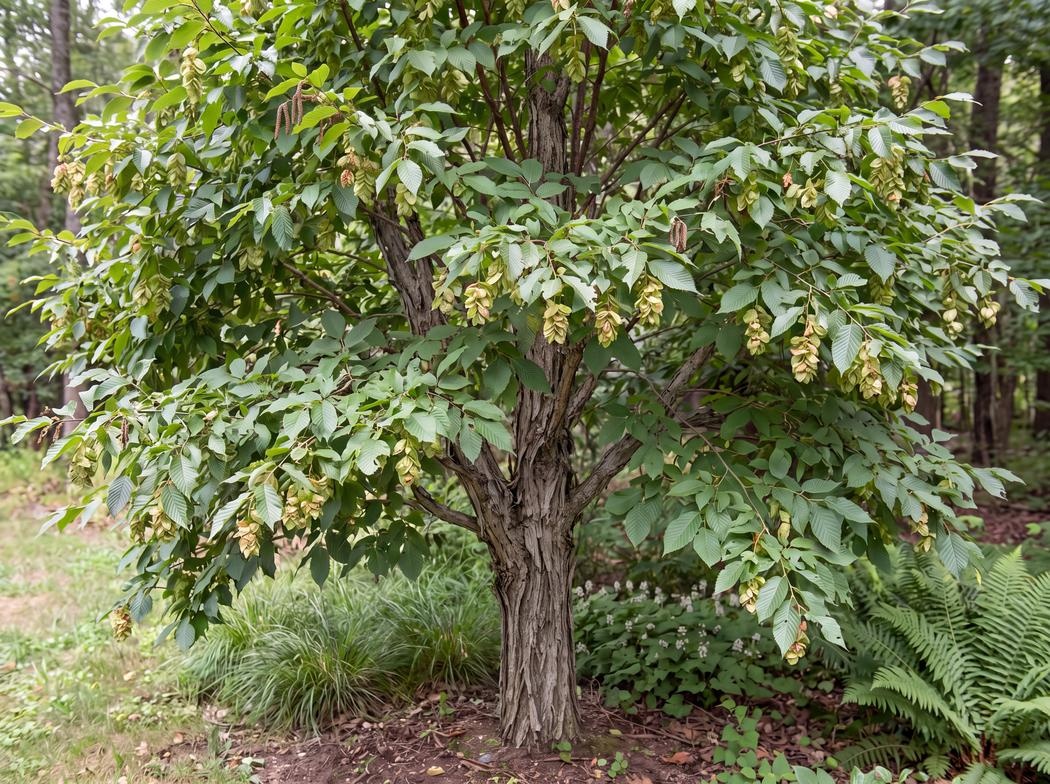
Ostrya virginiana

$499.99
Ostrya virginiana is a tough native understory tree with a rounded crown, yellow fall color, hop-like fruits, and attractive orange-gray peeling bark.
- Description
- Additional information
Description
Ostrya virginiana, the American hophornbeam, is a slow-growing North American deciduous tree with a fine-textured oval to rounded crown. Alternate green leaves have sharply double-serrated edges and turn a showy yellow in fall. Brown-green catkins are followed by hanging, hop-like clusters of nutlets that feed birds and mammals.
The orange to gray-brown bark peels in narrow longitudinal strips and adds winter interest. Grow the tree in full sun, partial shade, or open shade in well-drained clay, loam, or sand. It tolerates acidic to alkaline soil, drought, poor urban soil, and shade, but not wet ground or salt spray.
Use it as a specimen, shade tree, woodland-edge tree, or durable choice for courtyards and public plantings. Once established it needs little care, and serious pests and diseases are uncommon.
Additional information
| Height | 900 cm – 1200 cm |
|---|---|
| Spread | 750 cm – 900 cm |
| Flowering months | May, June, April, March |
| Family | Betulaceae |
| Propagation | Propagate by seed; collect the pale greenish-brown hop-like clusters before they shatter, then provide the cold stratification needed to overcome seed dormancy. |
| Pests | No pests are usually serious; two-lined chestnut borer, scales, basswood leafminer, and orange-humped mapleworm may occasionally occur. |
| Diseases | No diseases are usually serious; canker, leaf blister, leaf spots, and powdery mildew may occasionally occur. |
| Pruning | Little pruning is required. Remove dead, damaged, crossing, or diseased branches while maintaining the natural oval to rounded crown. |
| Hazardous | no |
| Variegated | no |
| Watering instructions | Water regularly during establishment. Once rooted, water during prolonged drought and always avoid waterlogged ground. |
| Sunlight instructions | Grow in full sun, partial shade, or open shade; the crown is denser in full sun. |
| Color flower spring | Green, Brown |
| Color flower winter | Brown |
| Aspect | East, South, West, North |
| Foliage | Deciduous |
| Habit | Bushy |
| Moisture | Moist but Well Drained, Well Drained Soil |
| Ph | Acid, Alkaline, Neutral |
| Position | Full sun, Partial shade |
| Shape | Oval, Round |
| Suggest planting location | Woodland Garden, Urban and courtyard gardens, Architectural planting, Wildlife friendly gardens |
| Type | Tree |
| Use for | Architectural, Low maintenance |
| Years to max height | 20 |
| Drought resistance | yes |
| Cultivation | |
| Soil | Clay, Loam, Sand |
| Local names | American Hophornbeam, Eastern Hophornbeam, Ironwood |
| Blomidon Item No | OSTVIR00045WB, OSTVIR00050WB |
| Usps | Hop-like fruits, yellow fall foliage, and peeling orange-gray bark provide multi-season interest., A drought-tolerant, shade-tolerant native tree that adapts to difficult urban soils. |